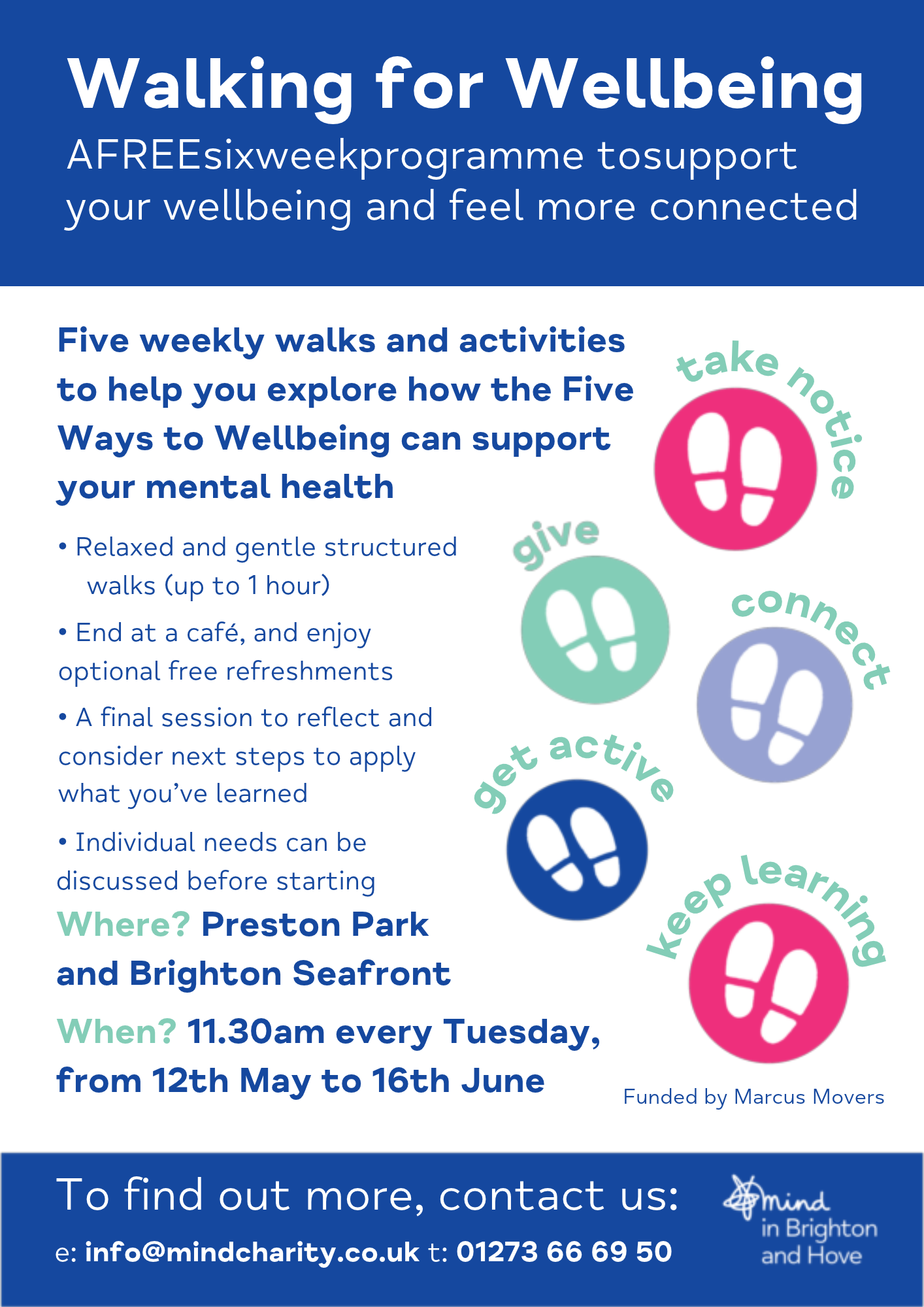




Five Ways to Wellbeing Walking Programme
The programme offered participants the chance to join a series of relaxed and gentle 1-hour walk giving them the opportunity to get outdoors and connect with others.
The Five Ways to Wellbeing Walking Programme was delivered during the summer 2026 in Brighton and Hove. The programme offered participants the chance to join a series of relaxed and gentle 1-hour walk giving them the opportunity to get outdoors and connect with others.
The programme was themed around the Five Ways to Wellbeing so participants could informally learn about how the Five Ways to Wellbeing can support their mental health and wellbeing.
There was a high level of peer support and each walk ended in an informal session in a local café so people could continue their conversations.
At the end of the programme participants were supported to develop personal wellbeing and activity plans to support them to continue to be active.
The outcomes and feedback were positive with all the participants who completed a pre and post questionnaire showing an increase in wellbeing or levels of physical activity. The combination of peer support, and incorporating the Five Ways to Wellbeing into the walk worked well and supported people to share their lived experience and what worked for them.
A follow up walk offered a month after the programme finished showed that people had continued to be active and several walkers had set up a WhatsApp group and had continued to meet for walks.
Feedback from the sessions included:
'I really like the group. I feel like I am with a group of people who get me. I can be myself with them because we all have our problems.'
'The walks give me a sense of purpose and connection.'
‘Meeting and chatting to new people, making new friends, feeling sense of belonging to something.'
The programme was funded by Marcus Movers.
Project Aims were:
· Offer a facilitated walking programme that was fully accessible and open to people with mental health issues.
· Support people to understand the Five Ways to wellbeing Model and how to incorporate it into their daily lives.
· Enable people to share their lived experience.
· Reduce barriers and through peer support help reduce social isolation alongside offering safe accessible physical activity.
· Provide people with an individual plan at the end of the programme to support them to move onto other opportunities in the city.
Why it is important:
· There is evidence to support that exercise and being in nature has a positive impact on mental and physical health.
· Research shows depression, anxiety and high stress levels (17%UK adults) can make it feel impossible to start exercising. Low self-esteem, poor body image, and fear of judgement can also common.
· Research also shows that people can have limited confidence to engage with mainstream exercise activities that may not understand their mental health challenges and physical abilities.
· Our experience shows people can feel safer sharing their lived experience in safe and supportive environments where there is a sense of community and/or peer support.